Artificial Intelligence Roadmap for Beginners
A beginner-friendly Artificial Intelligence roadmap covering Python, mathematics, machine learning, deep learning, NLP, computer vision, generative AI, and AI agents.
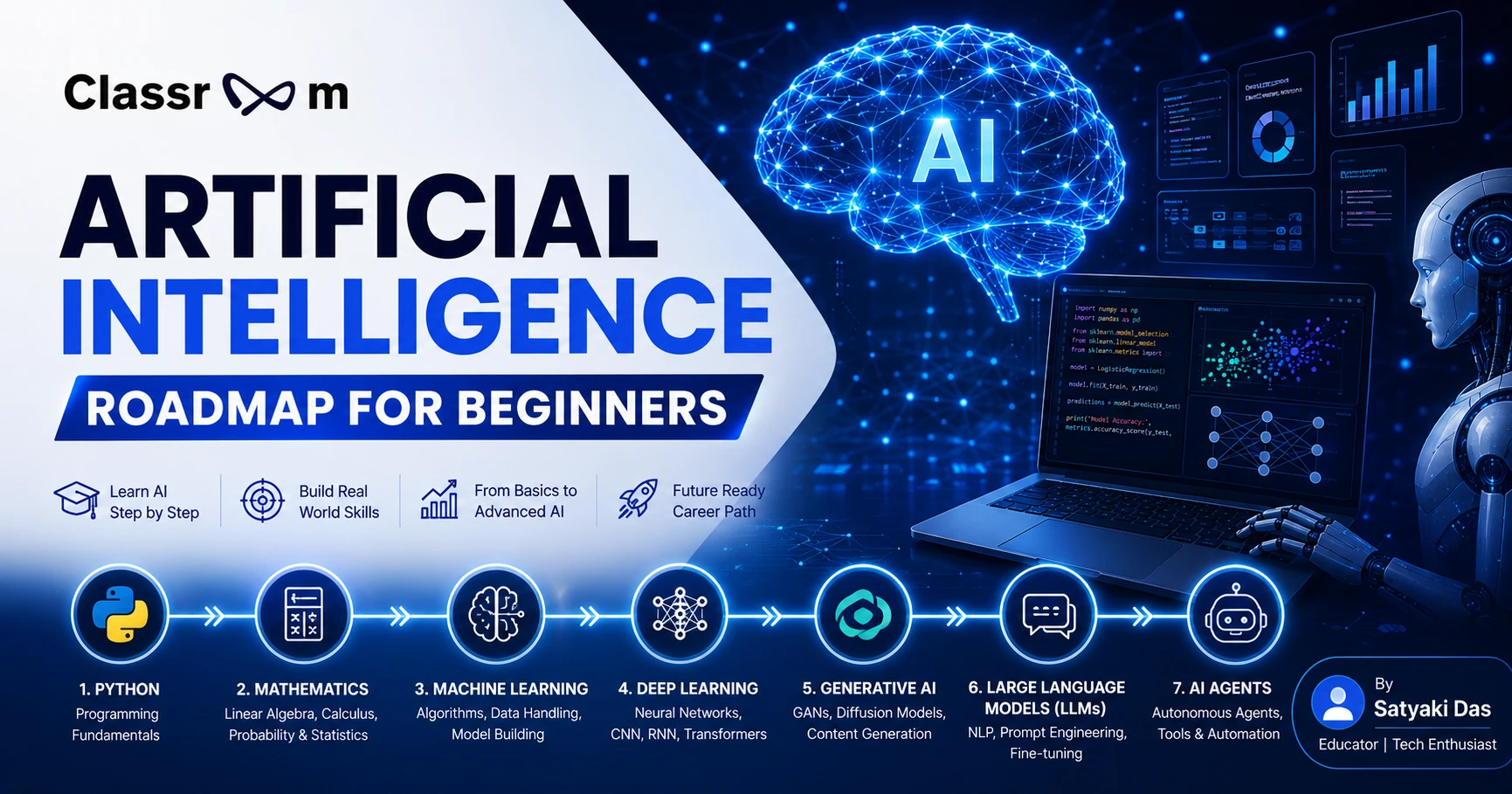
Artificial Intelligence (AI) has moved from research labs into everyday products — chatbots, recommendation engines, self-driving assistance, and generative tools students use daily. If you're wondering how to actually start learning AI instead of getting lost in buzzwords, this roadmap lays out a clear, beginner-friendly path for 2026 and beyond.
Quick Answer: To learn Artificial Intelligence as a beginner, build a foundation in Python and mathematics, understand core Machine Learning concepts, move into Neural Networks and Deep Learning, then explore specialized areas like NLP, Computer Vision, and Generative AI. Finish by building projects and understanding how AI Agents automate real tasks.
1. What Is Artificial Intelligence?
Artificial Intelligence is the broader science of building systems that can perform tasks that normally require human intelligence — reasoning, understanding language, recognizing images, and making decisions. Machine Learning and Deep Learning are techniques used to achieve AI; they are subsets of the larger AI field, not separate things.
2. AI vs Machine Learning vs Deep Learning
| Term | Definition |
|---|---|
| Artificial Intelligence (AI) | The broad goal: machines that mimic human-like intelligence |
| Machine Learning (ML) | A method to achieve AI by learning patterns from data |
| Deep Learning (DL) | A subset of ML using multi-layered neural networks for complex tasks |
3. Python and Mathematics Foundations
Every AI system is built on the same base: Python programming, linear algebra (vectors and matrices), probability and statistics, and basic calculus (gradients). You don't need to master these upfront — learn just enough to understand the "why" behind each algorithm, then deepen your knowledge as you progress.
4. Machine Learning Fundamentals
Before diving into advanced AI, understand supervised learning (regression, classification), unsupervised learning (clustering), and how models are trained, evaluated, and improved. This is the backbone that every advanced AI technique builds upon.
5. Neural Networks and Deep Learning
Neural networks are inspired by how the human brain processes information, using layers of interconnected "neurons" to learn complex patterns. Learn the basics of forward propagation, backpropagation, and common architectures like CNNs (for images) and RNNs (for sequences).
6. Natural Language Processing
Natural Language Processing (NLP) is how machines understand and generate human language — the technology behind chatbots, translation tools, and search engines. Start with tokenization, embeddings, and sentiment analysis before moving to transformer-based models.
7. Computer Vision
Computer Vision teaches machines to interpret images and video — used in face recognition, medical imaging, and autonomous vehicles. Beginners should start with image classification using CNNs before exploring object detection and segmentation.
8. Generative AI and Large Language Models
Generative AI creates new content — text, images, code, and audio — rather than just analyzing existing data. Large Language Models (LLMs) like the ones powering modern chatbots are trained on massive text datasets to predict and generate human-like responses. Understanding prompt engineering and how these models work at a high level is now a core AI skill.
9. AI Agents and Automation
AI Agents go a step beyond chatbots — they can plan, use tools, and complete multi-step tasks autonomously, such as researching a topic, calling APIs, or automating a workflow. This is one of the fastest-growing areas in applied AI and a strong differentiator on a student's resume.
10. Projects and Portfolio Building
Build a portfolio that demonstrates real understanding, not just tutorials followed step-by-step:
- A chatbot that answers questions from a document (RAG-based Q&A)
- An image classifier for a real-world use case (plant disease, handwriting, etc.)
- A sentiment analysis tool for product reviews
- A simple AI agent that automates a repetitive task
11. Career Opportunities in AI
AI skills open roles such as AI/ML Engineer, NLP Engineer, Computer Vision Engineer, Applied AI Researcher, and AI Automation Specialist. Employers increasingly test conceptual understanding through MCQs and applied problem-solving rounds, so regular topic-wise practice is just as important as building projects.
Explore AI practice questions on MockVita and check your understanding through topic-wise mock tests covering AI, Machine Learning, and Generative AI concepts. Start practicing on MockVita.
Frequently Asked Questions
Is Artificial Intelligence the same as Machine Learning?
No. AI is the broader goal of building intelligent systems, while Machine Learning is one of the main techniques used to achieve it. Deep Learning is a further subset of Machine Learning.
What should a complete beginner learn first in AI?
Start with Python programming and basic statistics, then move to Machine Learning fundamentals before touching Deep Learning, NLP, or Generative AI.
Can I learn AI without a computer science degree?
Yes. Many successful AI practitioners are self-taught or come from other fields. What matters most is consistent, structured practice and building real projects.
What are AI Agents in simple terms?
AI Agents are AI systems that can independently plan and execute multi-step tasks — like researching, using external tools, and making decisions — rather than just responding to a single prompt like a chatbot.
Related reading: Machine Learning Roadmap for Beginners · MockVita Practice Hub · Explore All Learning Roadmaps