Machine Learning Roadmap for Beginners in 2026
A step-by-step Machine Learning roadmap for 2026 covering Python, statistics, data preprocessing, ML algorithms, projects, and deep learning basics for absolute beginners.
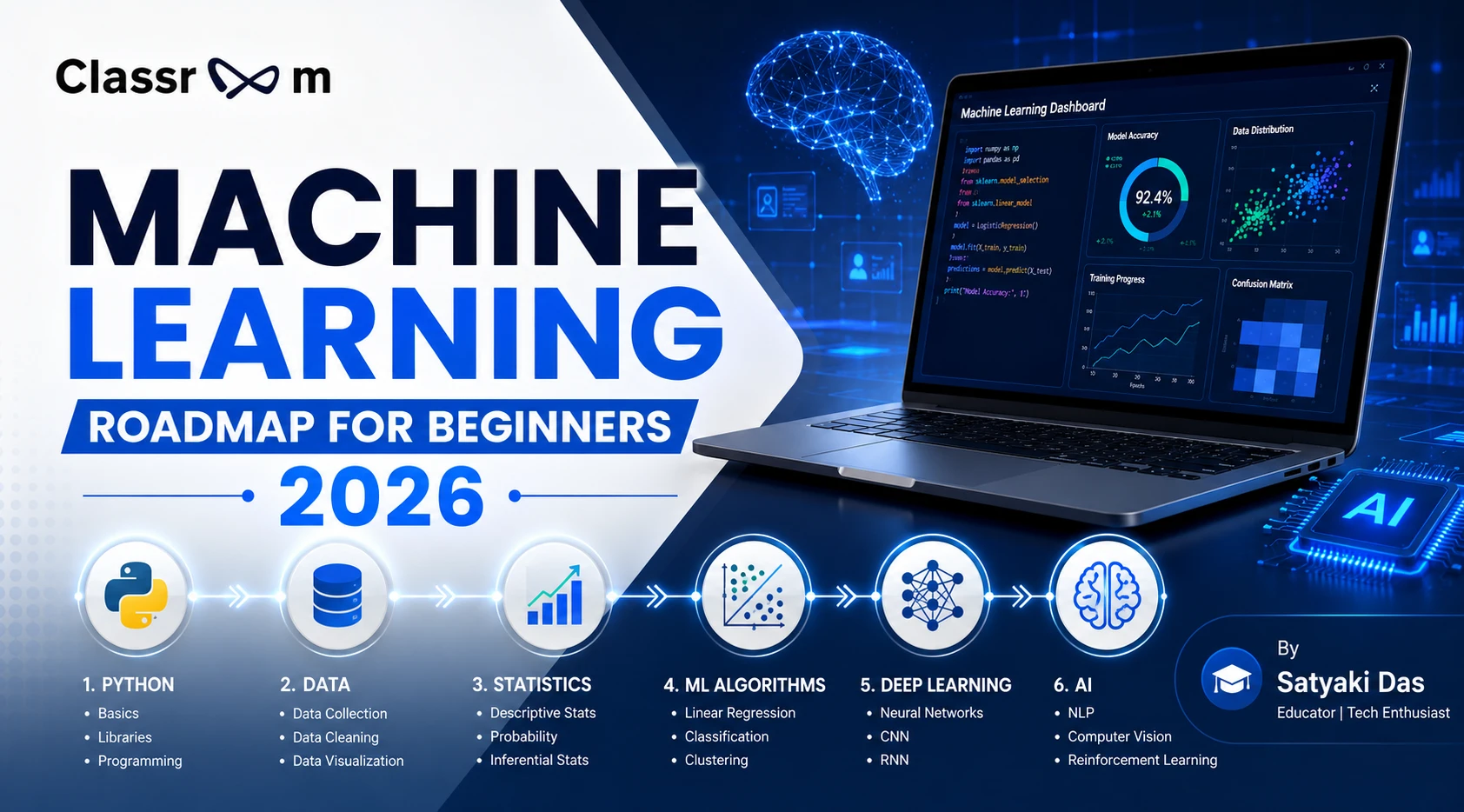
Machine Learning (ML) is one of the most in-demand skills for students and working professionals heading into 2026. But most beginners get stuck at the very first step: where do I even start? This roadmap breaks the journey into a clear, sequential path — from Python basics to deploying your first ML model — so you can learn with confidence instead of jumping between random YouTube videos and half-finished courses.
Quick Answer: To learn Machine Learning as a beginner in 2026, start with Python and basic statistics, move on to NumPy/Pandas for data handling, learn core ML algorithms (regression, classification, clustering) using scikit-learn, practice on real datasets, and then explore deep learning. Consistent practice with mock tests and small projects matters more than rushing through theory.
1. What Is Machine Learning?
Machine Learning is a branch of Artificial Intelligence where a system learns patterns from data instead of being explicitly programmed with rules. Instead of writing "if-else" logic for every scenario, you feed a model examples (data) and it learns to make predictions on new, unseen data — like recommending a video, detecting spam email, or predicting house prices.
2. Prerequisites: Python, Mathematics and Statistics
You don't need to master mathematics before you start, but you do need working knowledge of these areas alongside your coding practice:
- Python basics — variables, loops, functions, and object-oriented programming
- Linear Algebra — vectors, matrices, and matrix multiplication (used inside every ML model)
- Statistics & Probability — mean, median, standard deviation, distributions, and probability rules
- Calculus basics — derivatives and gradients, which power how models "learn" during training
3. NumPy, Pandas and Data Visualization
Real-world ML work is 70% data handling and 30% modeling. Get comfortable with:
- NumPy for fast numerical operations and array manipulation
- Pandas for loading, filtering, grouping, and cleaning tabular data (CSV, Excel, SQL)
- Matplotlib / Seaborn for visualizing trends, distributions, and correlations before modeling
4. Data Cleaning and Preprocessing
No dataset is perfect. You'll regularly deal with missing values, duplicate rows, inconsistent formatting, and outliers. Learn techniques like imputation, encoding categorical variables (one-hot / label encoding), feature scaling (normalization and standardization), and train-test splitting — these steps often decide whether your model performs well or poorly.
5. Supervised and Unsupervised Learning
Machine Learning problems generally fall into two categories:
| Type | What It Means | Example |
|---|---|---|
| Supervised Learning | Model learns from labeled data (input + correct output) | Predicting exam scores, spam detection |
| Unsupervised Learning | Model finds patterns in unlabeled data | Customer segmentation, anomaly detection |
6. Important ML Algorithms
You don't need to memorize every algorithm — focus on understanding when and why to use each one:
- Linear & Logistic Regression — simple, interpretable baseline models
- Decision Trees & Random Forests — powerful for structured/tabular data
- K-Nearest Neighbors (KNN) — intuitive similarity-based classification
- K-Means Clustering — grouping unlabeled data into clusters
- Support Vector Machines (SVM) — effective for classification with clear margins
7. Model Evaluation and Validation
A model that performs well on training data but poorly on new data is overfitting — one of the most common beginner mistakes. Learn to evaluate models using accuracy, precision, recall, F1-score, and confusion matrices, and use techniques like cross-validation to make sure your results generalize.
8. Build Beginner-to-Intermediate Projects
Theory alone won't get you hired or graded well — projects prove you can apply it. Good beginner project ideas include:
- House price prediction using regression
- Student performance / exam score predictor
- Movie recommendation system
- Customer churn prediction for a subscription business
- Spam email classifier
9. Introduction to Deep Learning and MLOps
Once you're comfortable with classical ML, move toward neural networks (the foundation of Deep Learning) and get a basic sense of MLOps — how models are deployed, monitored, and updated in production using tools like Flask/FastAPI for serving predictions and Docker for packaging.
10. Machine Learning Career Path
ML skills open doors to roles like Machine Learning Engineer, Data Scientist, ML Research Intern, and AI Application Developer. Recruiters increasingly test these fundamentals through MCQs and applied coding rounds — which is exactly why structured practice matters as much as learning.
Ready to test your ML knowledge? Practice Machine Learning MCQs and topic-wise mock tests on MockVita's Practice Hub and track your progress against real exam patterns.
11. Frequently Asked Questions
Is Machine Learning hard to learn for beginners?
It isn't hard if you follow a structured path. Start with Python and statistics, then move to libraries like scikit-learn before touching deep learning — jumping straight into advanced topics is what makes ML feel overwhelming.
How long does it take to learn Machine Learning?
With 1-2 hours of consistent daily practice, most beginners can learn core ML concepts and build their first projects within 3-4 months.
Do I need a strong math background to start?
No. Basic statistics and comfort with functions is enough to begin. You can deepen your linear algebra and calculus knowledge gradually as you progress to advanced algorithms and deep learning.
Which programming language is best for Machine Learning?
Python is the industry standard because of its simplicity and rich ecosystem of libraries like NumPy, Pandas, scikit-learn, and TensorFlow/PyTorch.
Related reading: Artificial Intelligence Roadmap for Beginners · MockVita Practice Hub · Explore All Learning Roadmaps